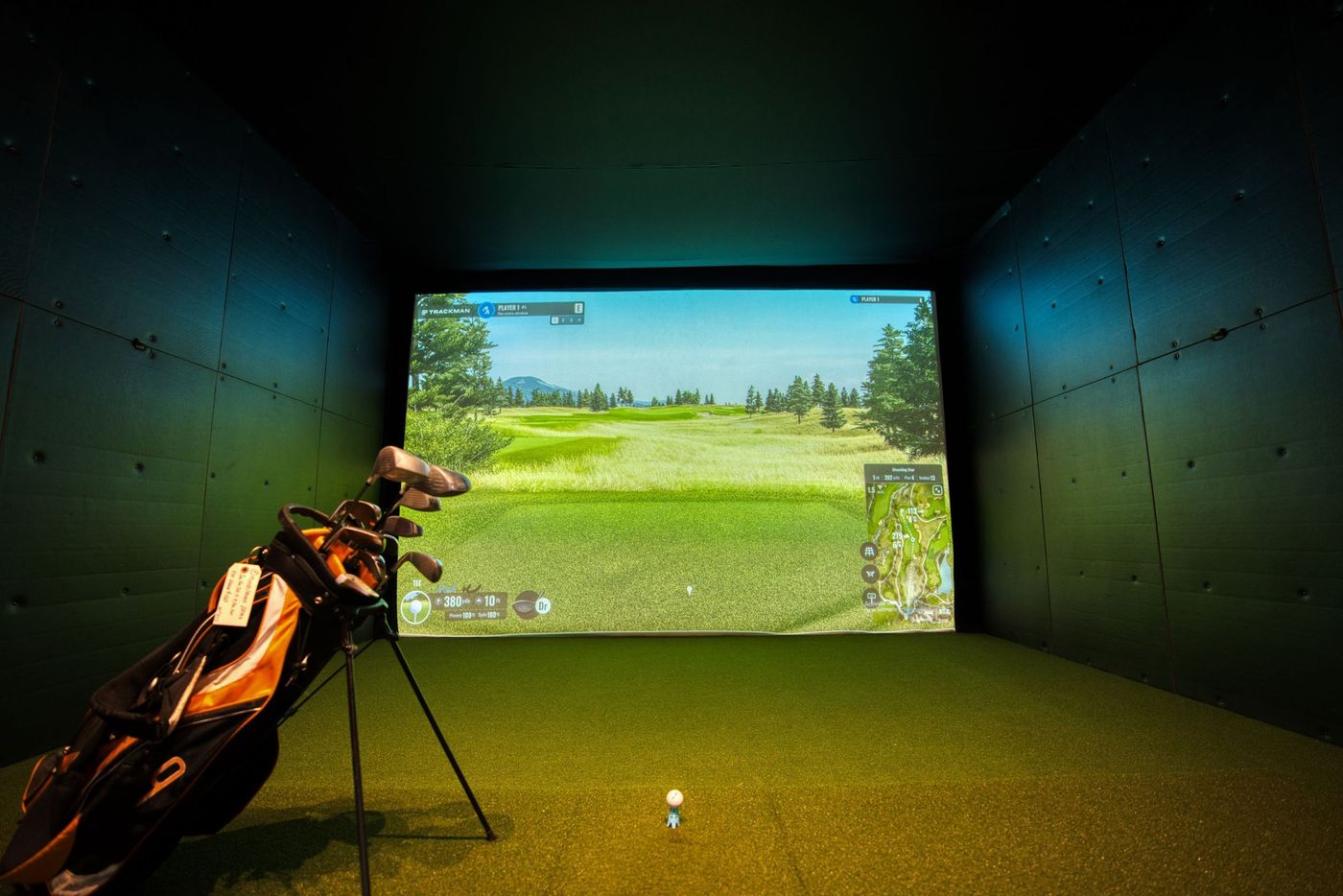
The short answer: a home golf simulator is four things: a launch monitor that reads the shot, an enclosure and impact screen that stop the ball, a hitting mat, and (if you want to play courses on the big screen) a short-throw projector. Plan for a room around 10 feet wide with a 9-foot ceiling. The easiest route is an all-in-one studio package; the cheapest route is a portable launch monitor plus a basic enclosure.
Published October 2026 · Room sizes from SkyTrak and Rapsodo; prices checked on Amazon and the Divot Depot store, October 2026
Already know you want a simulator and just need to pick the launch monitor? Our best golf simulators and launch monitors guide compares those head to head. This guide is about everything else: the room, the screen, the mat and the budget.
Step 1: Measure the Room First
The room decides almost everything else, so measure before you shop. The tightest dimension for most people is the ceiling, because you need to swing a driver without clipping it.
Rapsodo suggests 9 feet as the minimum ceiling for most indoor simulators, with taller golfers needing 10 or even 11 feet, and an ideal room of roughly 10 feet high, 14 feet wide and 17–18 feet deep. SkyTrak’s own sizing guide for its studio enclosures lines up closely:
| Studio size | Enclosure (W x H x D) | Ceiling needed | Minimum room width |
|---|---|---|---|
| 8 ft | 8 ft x 7 ft 5 in x 4 ft | 8 ft (or enough to swing driver) | 8.5 ft |
| 10 ft | 10 ft x 8 ft 6 in x 5 ft 4 in | 9 ft | 10.5 ft |
| 12 ft | 12 ft x 8 ft 6 in x 5 ft 4 in | 9 ft | 12.5 ft |
| 13 ft deep | 13 ft x 10 ft x 10 ft | 10.5 ft | 13.5 ft |
Source: SkyTrak simulator and studio sizing page, October 2026. SkyTrak recommends about 17 ft of total depth and 1–2 ft of extra width if both right- and left-handed golfers will play.
A quick test: stand where you would hit, take a slow full swing with your driver, and see what you hit first. If it’s the ceiling, plan around irons or look at a taller room.
Step 2: Pick the Launch Monitor
The launch monitor is the brain of the simulator, and it also affects the room. Radar units such as the Garmin Approach R10 sit behind the ball and need some ball flight before the screen to read the shot, so they need more depth. Camera and hybrid units like the SkyTrak ST MAX sit beside the ball and are easier in a shorter room. Whatever you choose, check the maker’s setup guide for exact distances before you buy the enclosure.
Our launch monitor comparison covers the SkyTrak ST MAX, Rapsodo MLM2PRO and Garmin R10 in detail, with current prices.
Step 3: Enclosure and Impact Screen
The enclosure is the frame and side netting that keep mishits off your walls; the impact screen is what you hit into and what the projector shines on. You can buy them together or separately. Bundles are simpler. Separate pieces let you size the screen exactly to your room.
A few things worth checking on any enclosure: whether the impact screen is included, how deep it is (deeper means more protection from shanks, but it eats room), and whether side barriers are included or extra.
GolfBays EasySim Enclosure
$799.00One size, 10’9” wide by 8’2” high by 3’3” deep, with poles, black side fabric and a Lite impact screen included. The 3-foot depth suits shorter rooms, and the 4:3 screen shape matches most projectors.
See it in our store →GolfBays SimBox Enclosure
From $1,529.10Seven sizes from 8’6” wide up to 13’2” wide, and GolfBays includes its PRO+ impact screen and side barriers. The 9’10”-deep versions add more protection if you have the room.
See sizes in our store →GolfBays Pro+ Impact Screen
From $550.00A commercial-grade screen sold in 26 sizes, for building into your own frame or replacing a worn screen. GolfBays backs it with a 9-month warranty.
See sizes in our store →Step 4: Hitting Mat
Don’t skimp here. A thin mat jars your wrists and elbows on every fat shot, and you will hit a lot of shots. Look for a thick shock pad under the turf and a size that lets you stand on the same surface you hit from.
GolfBays Standard Hitting Mat 4’11” x 4’11”
From $329.00A 4’11” square mat, big enough to stand on and hit from the same surface instead of a small strip of turf.
See it in our store →Step 5: Projector and Software
You can practice with just a launch monitor and a tablet showing your numbers. To play full courses on the screen you need a projector, usually a short-throw model so it can sit close to the screen without you standing in the beam. SkyTrak’s studio packages, for example, use the ZW350ST short-throw projector.
Budget for software too. Most launch monitors need a paid membership to unlock full courses, and plans change often, so check the current price on the maker’s site before you buy.
What a Home Simulator Actually Costs
| Build | What’s in it | Hardware cost |
|---|---|---|
| Budget | Garmin Approach R10 ($499.99) + GolfBays EasySim with screen ($799) + hitting mat ($329) | About $1,630, plus a projector if you want courses |
| All-in-one | SkyTrak ST MAX Standard Studio Package: launch monitor, enclosure, screen, frame, 5x5 mat and ZW350ST projector | $4,195 |
| Build your own | SkyTrak ST MAX ($1,695) + GolfBays SimBox with screen (from $1,529.10) + hitting mat ($329) | About $3,550, plus a projector |
Prices from Amazon (Garmin, SkyTrak) and the Divot Depot store (GolfBays), October 2026. Software memberships and installation not included.
SkyTrak ST MAX Standard Studio Package
$4,195.00Everything in one order, sold by SkyTrak on Amazon: the ST MAX launch monitor, enclosure, impact screen, steel frame, 5x5 hitting mat and ZW350ST short-throw projector, plus trial software. The listing is for the 10-foot studio, so check your room against the table above.
Check price on Amazon →Measure the ceiling first, buy the launch monitor second, and build the room around both.
Want to make the most of all those indoor reps? Pair the simulator with drills from our best golf training aids guide, or start with our free 20-minute practice routine.
How much space do you need for a home golf simulator?
Plan for about a 9-foot ceiling, 10 to 14 feet of width and around 17 feet of depth. SkyTrak’s smallest 8-foot studio needs an 8.5-foot-wide room and enough height to swing a driver; taller golfers may need 10 feet or more.
Can you build a golf simulator in a garage?
Often, yes, as long as the ceiling is high enough to swing a driver and you have room for the enclosure plus a few feet behind the hitting area. Measure the lowest point, including garage door tracks and openers.
How much does a home golf simulator cost?
A basic setup with a portable launch monitor, budget enclosure and mat runs about $1,600 before a projector. All-in-one studio packages like SkyTrak’s start around $4,200, and software memberships are extra.
Do you need a projector for a golf simulator?
Not to practice. A launch monitor and a phone or tablet show your numbers. A projector is what lets you play full courses on the impact screen.
Divot Depot original
We may earn a commission if you purchase through our links — at no extra cost to you. GolfBays products ship direct from the brand through the Divot Depot store.